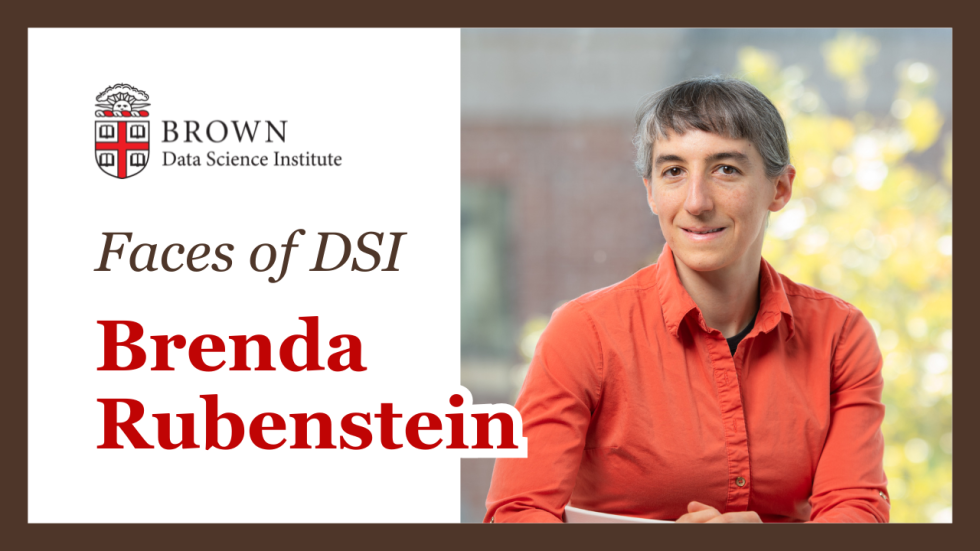
Can you introduce yourself and your role at the Data Science Institute?
My name is Brenda Rubenstein. I am the Vernon K. Krieble Professor of Chemistry, a Professor of Physics, and, now, the Director of DSI. As DSI Director, I am focused on shaping the Institute’s vision for the next few years.
I think about how we fundraise, support new initiatives, and make sure we are doing all the things we are meant to do. That includes providing research funds across campus, helping train students, creating strong master’s programs that broaden people’s understanding of data science and policy, and supporting all our centers, such as the Center for Computational Molecular Biology (CCMB) and the Center for Technological Responsibility, Re-imagination, and Redesign (CNTR).
What brought you to Brown DSI?
I was a Brown undergraduate, Class of 2007. I graduated with degrees in Chemical Physics and Applied Math, and I probably would have added Biochemistry too, but back then, you had to pay for extra concentrations.
After graduating, I worked for the Department of Energy for several years, then came back to Brown in 2016 to join the Department of Chemistry. My work is fully computational, so I immediately became a DSI affiliate. I served on the DSI’s campus advisory board, and last year I was named Director of the DSI.
How did you come to study computational physical sciences?
My research sits at the intersection of biology, chemistry, physics, and computation. We use computational principles to understand life, chemistry, and materials. More technically, we are experts in quantum mechanics and statistical mechanics. We apply those tools to different problems.
I have always been fascinated by the intersection of biology, computation, and mathematics. When I was younger, I started as a kind of “baby biochemist,” doing wet lab work. I even worked on the first SARS vaccine, long before COVID.
At some point, I realized that wet lab science, while important, does not scale easily. It requires hundreds of people doing repetitive experiments. That made me realize the future would be computational.
Back then, computation meant using physics and chemistry based principles to model systems. In the last five to ten years, machine learning and data driven approaches have exploded. We have gone from using fundamental physical laws to describe life to using data itself to drive predictions that are faster and more accurate.
My path evolved gradually. I have always been interested in biology and health, but eventually saw that computation was the future. I am very glad I made that shift.
Now, my lab studies quantum materials, or materials with unique properties when cooled to very low temperatures. We try to understand these materials, how they behave, and the specific properties they have.
We are also heavily involved in quantum computing and exploring how to model biological systems on quantum computers for the first time. Even if those systems are not fully ready yet, we are working on the theoretical groundwork for when they are.
We also study computational biophysics, predicting protein and RNA structure and function. An earlier part of my group worked on alternative computing, which explores how to make unconventional materials such as molecules or even cells perform computations. The work has since spun off into a company we founded from Brown.
Is there a research project you are most excited about?
Yes. Right now, I am most excited about trying to compute biology on a quantum computer for the first time.
Quantum computers are incredibly promising. They could allow us to study certain systems more accurately and efficiently than ever before, but they still face challenges. They are small, noisy, and not yet scalable.
We are working to push the limits of what these early quantum computers can do and to show that they can already perform meaningful work in biology. Specifically, we are simulating biochemical reaction dynamics, which describe how proteins and complexes interact and how drugs might target them. In the past, these kinds of calculations were very expensive and not always accurate. With quantum computing, we may eventually study them with far greater precision and lower computational cost. It is an exciting frontier.
As DSI Director, how will you shape the future of the Data Science Institute?
Being the DSI Director is both fun and challenging. I really enjoy thinking about the Institute’s future, where we can grow, and how we can make an impact. We have an incredible community here with the staff, students, and faculty doing diverse and fascinating research.
I am currently focused on growing the portfolios of DSI and the centers within it. The AI and policy space is expanding rapidly, and we are building partnerships with Computer Science and the AI Initiative at Brown to make DSI a true hub for research at the intersection of AI, humans, and policy.
We are also strengthening the connection between computation and biology. With the RNA Center nearby and the Human RNome Initiative coming to Brown, CCMB is positioned to be a leader in that area.
Beyond that, I want to deepen DSI’s ties to the physical sciences, engineering, and humanities. The CNTR already bridges some of that work, but I would like to see even more collaboration, especially since so much AI research is happening not only in computer science but also in physics, chemistry, applied math, and engineering. I am thinking about how to expand DSI into new areas, bridging the humanities or engineering to create collaborations that connect people across campus.
What is the most rewarding part of your work?
Definitely the students. I would not be at Brown if it were not for my love of teaching and mentoring. Helping people grow into who they want to be is deeply rewarding.
I also love those sparks of innovation, when something new clicks and you realize you have discovered or thought of something no one else has. That mix of mentorship and creativity is what gets me out of bed on Mondays.
What do you like to do for fun?
Most people on campus know I am in the gym every morning at 6 AM. That is my routine. Athletics have always been a big part of my life. I actually came to Brown on an athletic scholarship.
I live in New Hampshire, which I think is one of the most beautiful states in the country. I love hiking, kayaking, and spending time outdoors. There is a lake near my home that I often have all to myself. It is quiet and peaceful and a great way to recharge.