Note: This interview has been edited for clarity.
Who are you and what do you do at the Data Science Institute (DSI)?
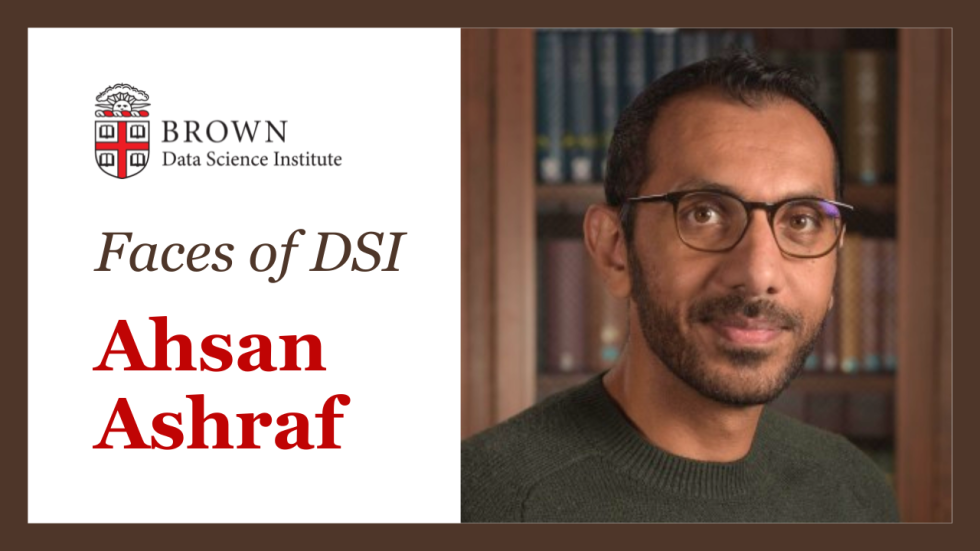
My name is Ahsan Ashraf, and I’m an Assistant Professor of the Practice of Data Science. I’m also the Director of Industry and Research Engagement, where I try to make connections between DSI, the faculty at Brown, and industry partners.
How did you find your niche in data science?
Prior to working in industry, I was in academia as a physicist. I did my training in condensed matter physics at a national lab in New York, working on building materials for novel, sustainable energy technology like solar cells, batteries, and so forth.
Towards the end of my PhD, however, I realized what I really enjoyed most about my work was actually the data science and machine learning components. I started focusing on those quite a lot, and then I decided to move out to California to actually start working in the industry. I was a senior data science manager at Pinterest where I focused on recommendation systems for about eight years or so. I had some other jobs before that in startups, also concentrated on recommendation systems.
In the early 2010s, machine learning and data science were really developing as fields. There weren’t any degree programs like the Data Science Master’s at Brown now, and people working in the field were often just other scientists, like physicists, mathematicians, and neuroscientists, trying to build the field from the ground up. I saw this tremendous potential and opportunity to be involved in something early and to help shape its direction and future.
I really do believe that this is a field that, for better or for worse, is going to change our future and impact the next generation. A lot of my research now involves building machine learning systems while also trying to understand the ethical repercussions and implications of that work. I want to be involved in shaping that future.
In terms of transitioning back to academia, what I really missed was the collaborative environment that you get by working with other faculty members and people in very different research disciplines, which allows you to do some really exciting stuff. I think data science as a field is at a point where it's mature enough that there's a lot of opportunity to be able to work and collaborate with other people. That's what I'm really excited about, and being able to bring my industry experience to Brown.
What do you see as the current challenges in the field of data science, and how can we address them?
My interests have slowly evolved from recommendation systems to understanding how to build inclusive and fair recommendation systems from the perspective of creating a product that everyone can benefit from. I realized that these systems are not just better from an ethical perspective, but they’re also good for business.
I’ll give an example from Pinterest, where I was working before. Pinterest is a discovery engine for finding ideas. For a lot of people, when they went to look for a product, they didn't connect because they didn't see people that looked like them; they didn't see content related to their specific hair type or body type. Being able to incorporate signals about skin tone and hair patterns into the product allows us to create a more diverse recommendation system. This serves users who, earlier, weren't able to connect to the product, which made the product both more equitable and inclusive, also better commercially.
Something that I'm really interested in is the constant back and forth between technological development and policy catching up to that technological development. We're seeing this with GDPR, and now with the AI Safety Act in Europe. It's always the case, at least so far, that policy is lacking.
I believe a lot of these technologies have the potential for harm, even if it’s an outcome that wasn't designed for. We need to be really proactive about thinking through the different implications of the technological advancements we're creating and how they're being rolled out to the world.
The role of academia in this specific problem is crucial. We can be the "voice of reason," making sure the right checks and balances are in place. There’s also an opportunity for academia to be leading the way in the sense of being able to understand these systems better, to pull them apart and stretch them in ways that they're not being perhaps used for at the moment, to understand the limits and the gaps in these systems.
As the Director of Industry and Research Engagement, how are you shaping the DSI Master’s Program?
I think this role is quite unique in the sense that you have to be able to bridge these two worlds, academia and industry, and two ways of working. Sometimes the goals are quite distinct, where academia focuses on publishing papers, while industry focuses on business impact.
Having both my academic background and industry experience is useful because when I talk to research partners, I understand their incentives and goals. I can translate the industry expertise I've gained and talk to them about how we might be able to work together in a way that is mutually beneficial.
As the Director of Industry and Research Engagement, I’m primarily focused on two things:
The first is being able to bring the expertise and skill sets from industry to students at Brown. Theoretical data science in classes can often be quite different from the work done in industry, and I want to ensure that students are exposed to the type of work being done in the field and understand how course content translates to the real world.
The second component is more about being able to build a community. This involves fostering a close collaborative relationship with our alumni, local research partners, nonprofit organizations, and other community partners in Rhode Island. I'm also really excited to start involving local governments to see how our expertise can help the community around us.
I've already engaged with a lot of partners within Brown and in my network in the industry. We're already getting people to come and talk to our students. For instance, we recently had a talk where the Director of Machine Learning from Wayfair came to discuss the type of machine learning techniques they use in their product. I'm really excited about the momentum we have going. I hope that this can continue over the years and we build relationships that can last for a long time.
What courses and research are you leading at DSI?
I'm teaching the Data Engineering course right now, which is a required introduction course for our Master’s students. I taught a similar course previously at Berkeley. It's a foundational course that allows people to understand everything to do with data pipelining and creating functioning and robust systems that can get clean, reliable data through your system before any machine learning or analytics can happen.
Next semester, I'll teach the Applied Data Practicum, which allows students to work with industry and research partners on interesting topics. For example, a project done in the past was with Citizen’s Bank, where the aim was to detect similarities between two signatures. It was an interesting project that used computer vision technologies to create embeddings for these images and matched them with confidence. These projects are useful for the businesses and good learning experiences for the students.
Why do you think the Brown Data Science Institute is unique?
I find the DSI community to be really amazing. Data science, by its very nature, is interdisciplinary and requires collaboration and communication across the campus. I think DSI really embodies that, being able to be that central place where everyone can come to create that community around data science, while also developing their core curriculum. I think DSI strikes that balance pretty well.
What do you do for fun outside of work?
Outside of work, most of my time is spent with my daughter, who's two right now. She's at a really fun age right now, developing a great personality, and she's talking and walking a lot, so it's really fun.